
Home Alarms Melbourne: Expert Guide 2026

Victoria recorded almost 28,000 residential burglaries in 2025, and RACV said a home in the state is burgled about every 20 minutes. For Melbourne homeowners, that changes the conversation around home alarms Melbourne from “nice to have” to a practical layer of protection, especially in suburbs where people leave homes empty during commutes, school runs, and weekend trips. The key question isn't whether a siren is loud enough, it's whether the whole system has been planned, installed, and configured to reduce risk without creating false alarms or compliance problems.
Table of Contents
Why Melbourne Homeowners Are Upgrading Security in 2026
Victoria's burglary numbers are hard to ignore. RACV reported almost 28,000 residential burglaries in 2025, a 14% increase on the previous year, and its hotspot analysis said a home is burgled about every 20 minutes across the state. That doesn't mean every Melbourne suburb faces the same exposure, but it does mean the overall risk environment has moved enough that security planning is now part of ordinary household maintenance, not a luxury add-on. The RACV figures are a strong benchmark for homeowners deciding whether to upgrade a dated alarm or install one for the first time. RACV burglary analysis
Victoria Police also recorded 474,937 criminal incidents in the year to 31 March 2025, up 20.1% from 395,313 the year before. In Melbourne terms, that matters because metropolitan housing stock is varied, detached homes in outer suburbs, townhouses in middle-ring streets, apartments, and period homes with side access all create different points of entry and different blind spots. The more fragmented the layout, the more important proper sensor placement and camera coverage become.
What the numbers mean for different homes
A family in a single-fronted terrace has different weak points to a property in a new estate with a rear lane, but both can be targeted during short absences. That is why professionally installed alarms, sensors, and monitoring are treated as a baseline in many Melbourne homes, not an optional extra. A quick DIY siren may deter casual opportunists, but it won't compensate for poor zoning, weak power backup, or a camera that points at the wrong boundary. For readers comparing recent Melbourne break-in trends with practical home security options, this local overview of Victorian burglary risk gives useful context.
Practical rule: if a home can be entered without crossing a monitored perimeter, the system is already behind the problem.
That's why 2026 buying decisions are less about brand names and more about architecture, entry points, monitoring method, and compliance. In the Melbourne market, those details matter more than glossy app screenshots or oversized sirens.
Professional Installation Versus DIY Systems
DIY kits can work in simple spaces, but Melbourne homes rarely stay simple for long. A weatherboard in Preston, a townhouse in South Yarra, and a renovation in a bayside suburb all need different coverage logic, different cable paths, and different decisions about where alarms should arm, stay silent, or trigger instantly. A kit off the shelf usually assumes a flat, predictable layout. Real homes don't behave like that.
The biggest gap is not the hardware, it's the design. Professional installers map the property, decide which doors and windows deserve contacts, where motion sensors won't be fooled by heat or pets, and whether cameras should cover the gate, driveway, side access, or rear boundary. DIY owners often mount devices where power is convenient, not where the intruder path runs.
Feature | DIY System | Professional Installation |
|---|---|---|
System design | Based on kit defaults and whatever the owner can fit | Based on property layout and risk points |
Sensor placement | Often trial-and-error | Planned around entry routes and blind spots |
Cable management | Usually visible or improvised | Neat runs, hidden where possible |
Maintenance | Owner's responsibility | Installer can handle commissioning and servicing |
Monitoring setup | Often self-managed | Can integrate with professional monitoring and app control |
Compliance awareness | Easy to miss local requirements | Built around standards and building rules |
That table captures the trade-off Melbourne owners run into most often, convenience versus certainty. A DIY alarm may be acceptable for a low-complexity unit where the owner is technically confident and willing to test and maintain it. For a large family home, a multi-level property, or any place being renovated, professional installation usually makes more sense.
Another issue is long-term upkeep. DIY systems drift when batteries age, firmware goes stale, or owners forget why a sensor was placed in a particular spot. The local guide at PeakFriend's comparison of professional home security and DIY reflects the same reality many installers see on site, simple systems are easy to buy, but harder to keep reliable.
A cheap install can become an expensive reset if it misses one access point or keeps triggering nuisance alarms.
For Melbourne homeowners, the decision is not whether DIY can work at all. It's whether the property, the owner's technical comfort, and the consequences of a miss all line up. If they don't, professional installation is the safer path.
What to Expect from Professional Alarm Installation
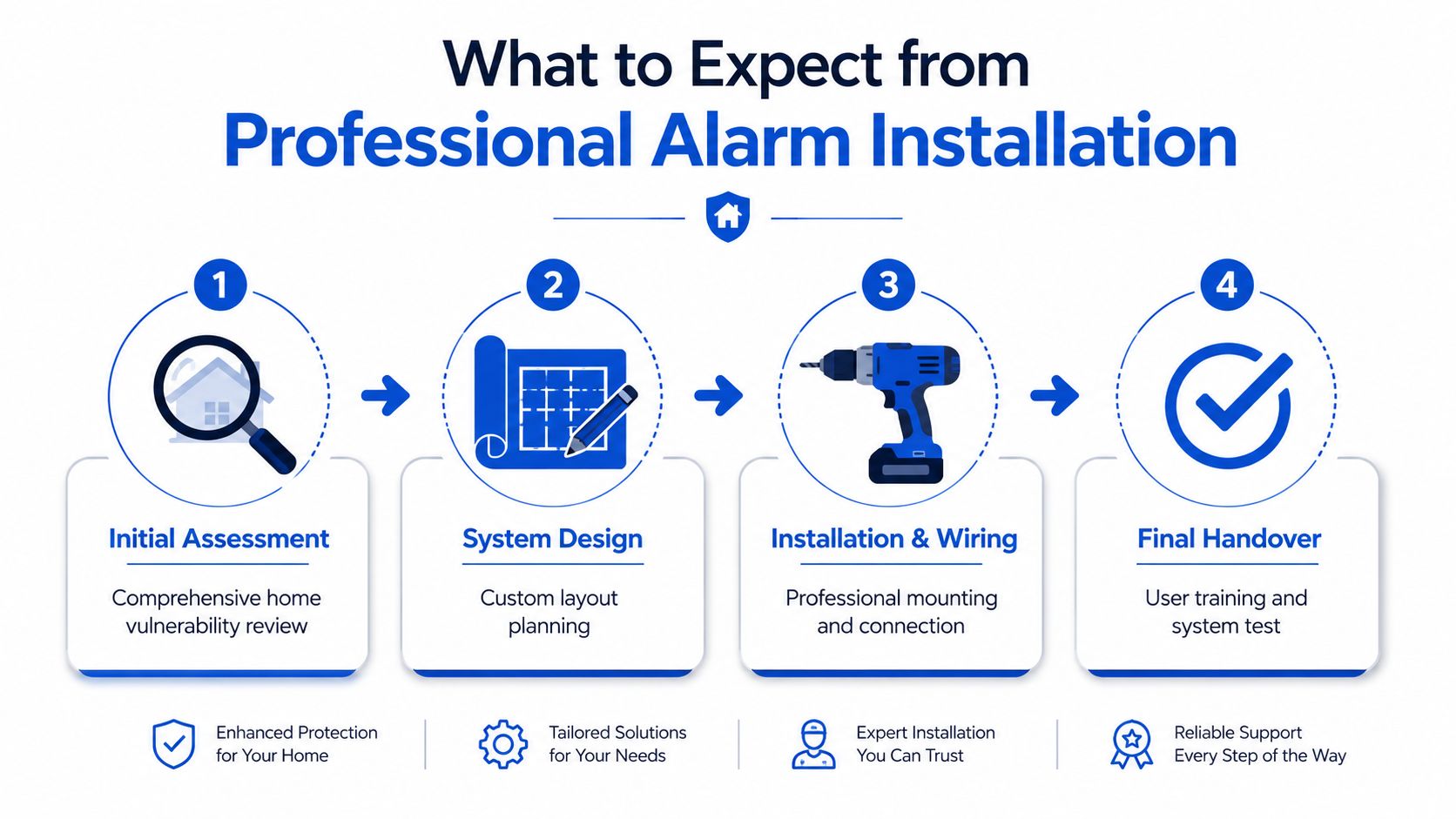
A proper installation starts before any tools come out of the van. The installer should walk the property, check access points, identify likely intrusion paths, and note anything that could create false triggers, such as ceiling fans, airflow, reflective surfaces, pets, or awkward room shapes. Good installers also ask about daily routines, because a system that fits a household's movement pattern is less likely to be bypassed or left partially armed. In Melbourne suburbs, that property walk matters even more, because a compact terrace in Richmond, a family home in Glen Waverley, and a weatherboard with side access in Reservoir all create different alarm risks.
The install day should feel controlled, not improvised
On the day, quality work is usually tidy and methodical. Cables should be routed cleanly, sensors should be mounted with the property's structure in mind, and cameras should be checked for angle, glare, and coverage gaps before anyone leaves. Commissioning matters too. A system is not finished until the installer tests every zone, verifies app access, confirms alerts, and makes sure the siren and monitoring path behave the way they should.
If the property includes smart locks, video doorbells, or CCTV, setup should also cover user permissions and notifications. That matters because a well-built alarm becomes more useful when it speaks to the rest of the system, rather than living as a separate box on the wall. Installers should explain how partial arming works, how to arm the perimeter only, and what to do when the system needs maintenance or a battery change. In homes with pets, that walkthrough should also cover which sensors are active in day mode and which ones should stay out of the family's normal movement path.
Good handover standard: the homeowner should be able to arm, disarm, test, and review alerts without guessing.
What homeowners should walk away with
The handover should leave the owner with more than an app login. At minimum, they should understand:
Which zones are protected: doors, windows, internal motion, and any camera coverage.
How to test the system: so routine checks don't become a source of anxiety.
What triggers an alarm: especially if pets, airflow, or open-plan rooms are involved.
Who to call for service: because a system that can't be maintained becomes a liability.
That's the part many Melbourne homes miss when they chase hardware first. A professionally installed alarm is not just a device on the wall, it is a mapped, tested, and explained system that fits the dwelling. For homeowners who want the full service model, PeakFriend Security offers property-specific assessment, installation, app setup, and ongoing maintenance, which suits complex homes better than a box-ticker installation. The practical difference shows up later, when a sensor needs repositioning, a user is added, or a false alarm pattern needs to be traced back to the room layout.
Understanding Monitoring Options and Response Times
Monitoring changes how an alarm behaves once it is triggered. A self-monitored setup sends alerts to a phone, which works if someone can check the message straight away, call neighbours, or review camera footage. Professional monitoring adds a human response layer, so the alert does not depend on whether the owner is in a meeting, on a plane, or asleep.
The trade-off is straightforward. Self-monitoring gives more control and avoids ongoing monitoring costs, but the homeowner has to act quickly and consistently. Professional monitoring costs more, yet it reduces the chance that a real alarm is missed because no one saw the notification in time. For households that travel often or manage more than one property, that difference can matter more than the hardware itself.
Matching monitoring to the property
Melbourne properties do not need the same level of oversight. An apartment with controlled entry may only need app alerts and selective camera coverage. A freestanding house with side access, a rear shed, and regular empty periods has a stronger case for monitored response, especially if the owner wants a response path that does not rely on checking a phone in real time.
For households comparing monitoring options and response setup, the useful question is not which system sounds most advanced. It is which setup matches the property type, the entry points, and the way the household lives. In older terrace homes, narrow side access and shared boundaries can make false alerts more likely if devices are placed without care. In newer townhouses, the issue is often whether the panel, app, and response process are clear enough for everyone who lives there.
Response planning matters more than the siren tone. If nobody is set up to act on the first alert, the system is only doing half its job.
What to ask before choosing a monitoring model
A homeowner comparing monitoring options should ask three practical questions. Who sees the alert first. What happens if the phone is off or unavailable. And how does the system deal with false triggers without creating alert fatigue. Those answers matter because a system that cries wolf too often gets ignored, while a system that stays quiet when it should not is no better than a dead battery.
Professional monitoring is often the cleaner fit for families, frequent travellers, landlords, and anyone with a property that sits empty for long stretches. Self-monitoring can still work well for smaller homes or owners who want direct control, but it needs discipline and a clear routine. The right choice is the one that fits the household's actual routine, not the one that sounds smartest in a brochure.
Avoiding False Alarms and Configuration Mistakes
False alarms usually come from design errors, not bad luck. A motion sensor aimed at a heater, a camera watching too much public footpath, or a contact placed on a door that rattles in the wind can turn a good system into a nuisance. The common Melbourne mistake is assuming that more devices automatically means better security. It doesn't.
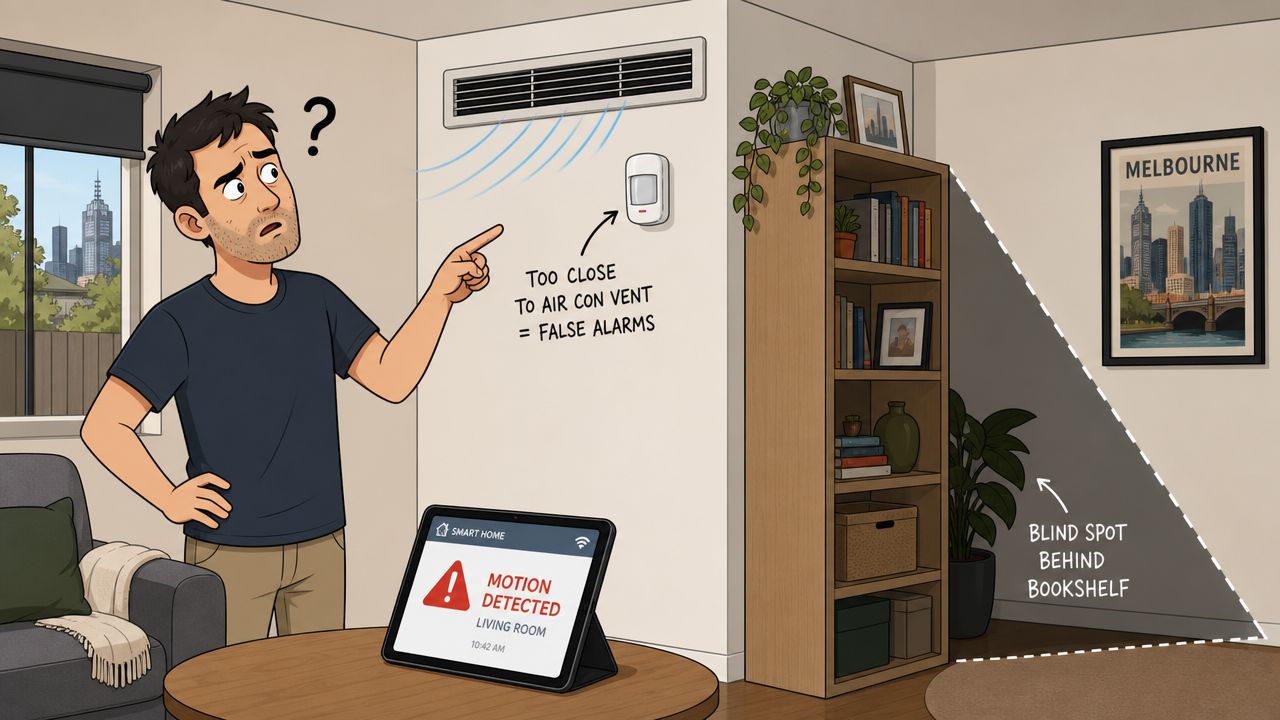
Sensor placement should follow the property's layout, not the easiest drilling spot. Motion detectors belong where an intruder must pass, not where pets roam freely or where airflow will trigger temperature changes. Door and window contacts should sit on openings that are regularly used, and cameras should cover approach routes without pointing into neighbouring living spaces.
The mistakes that cause the most trouble
A 2025 Melbourne guide on smart security singled out common homeowner mistakes such as poor sensor placement, boundary camera positioning problems, weak authentication, and skipped updates. Those are the exact errors that turn a security system into a maintenance headache. The fix is usually boring, but effective, layout-based device mapping, quarterly checks, automatic updates, and a clear view of what each sensor is meant to protect. Melbourne smart security mistakes guide
Camera privacy is part of the same problem. A lens that captures too much of a neighbour's yard or window creates friction that has nothing to do with theft prevention. The better approach is narrow, deliberate coverage that records the property's own entry points, not the street for the sake of it.
The old link between camera placement and privacy is one reason layered protection works better than brute-force coverage. Perimeter zones, internal zones, and partial arming let the owner secure the property without forcing every sensor to act the same way at every time of day. That's especially useful in family homes where people move through the house differently at night than during the day.
A small amount of tuning prevents most nuisance alarms. That means checking firmware, reviewing camera alerts, and rethinking placements after renovations or furniture changes. Security systems don't fail only at installation, they also fail when the house changes and the system never catches up.
Victorian Compliance Requirements You Must Meet
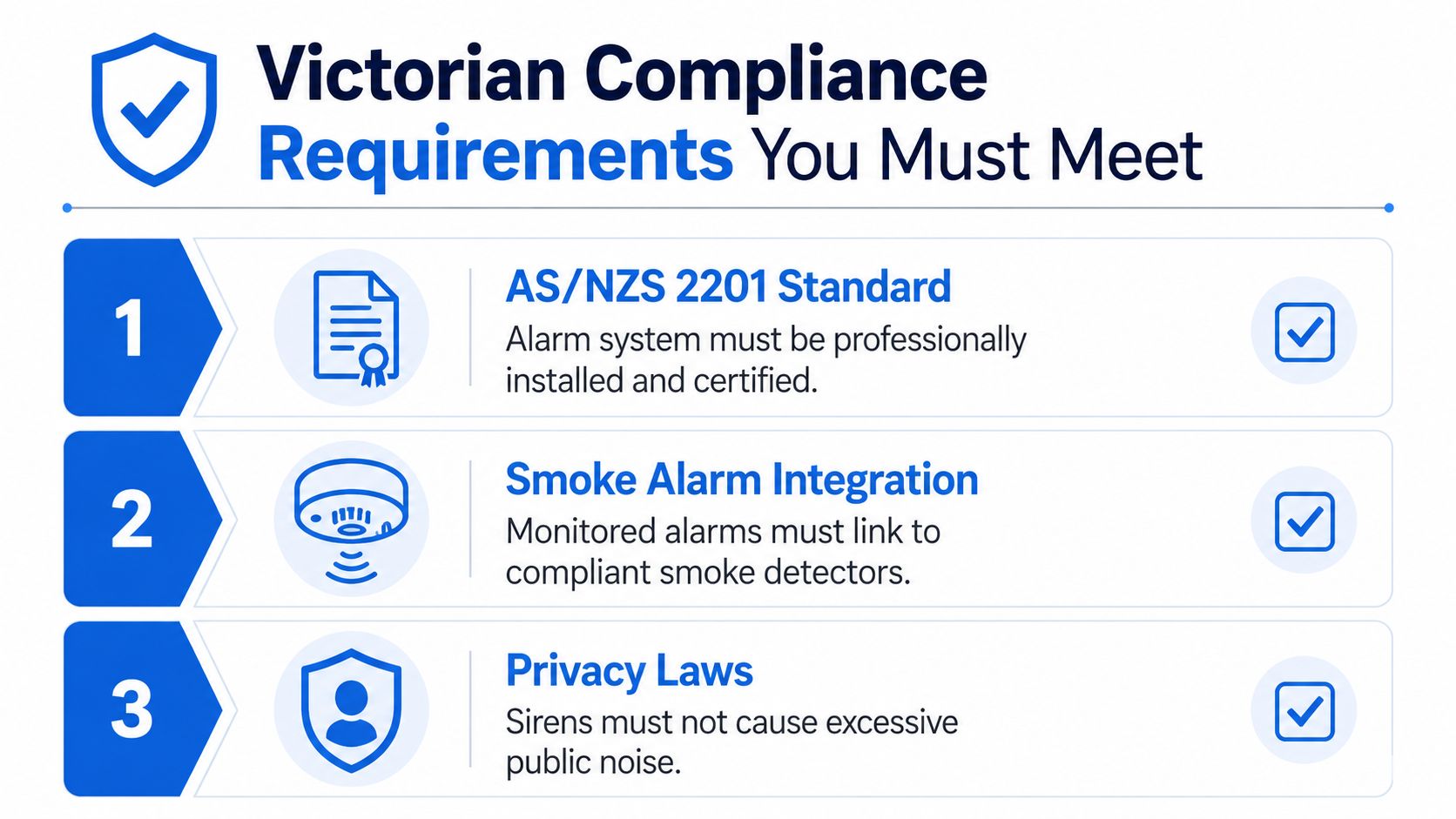
Victoria treats alarms and smoke detection as compliance issues, not just household preferences. For intruder systems, the relevant standard is AS/NZS 2201.1:2007, which sets minimum requirements for client-premises systems, including construction, operation, maintenance, and maintenance-contract guidance. That means a Melbourne install should be documented and treated as a standards exercise, not just a hardware swap. AS/NZS 2201.1:2007
For smoke alarms, the rules are even more property-specific. Victorian fire guidance says homes built before 1 August 1997 can use stand-alone 9-volt battery smoke alarms, homes built or substantially renovated after 1 August 1997 require hard-wired alarms with battery backup, and homes built, largely renovated, or extended after 1 May 2014 must have interconnected hard-wired alarms. That date-based framework is useful because it lets homeowners and landlords work from the dwelling's history rather than guessing what should be installed. Victorian Fire Services smoke alarm guidance
A practical compliance checklist
Check the build date: match the alarm type to the home's construction or renovation history.
Confirm every storey is covered: Victoria requires at least one working smoke alarm on every level.
Check placement near sleeping areas: alarms should sit between bedrooms and the rest of the home.
Verify interconnection where required: if one alarm sounds, all must sound together.
Keep documentation: installation records help with insurance and maintenance tracking.
Victorian smoke alarm laws also require working alarms in residential properties under the Building Act 1993 (Vic), Building Regulations 2018 (Vic), and Residential Tenancies Act 1997 (Vic), with alarms placed on every storey and near sleeping areas. Victorian smoke alarm compliance overview Hobsons Bay Council adds a useful placement reminder, alarms should be on or near the ceiling of every storey and positioned outside bedrooms or within each bedroom where appropriate. Hobsons Bay smoke alarm placement guidance
For combined smoke and alarm setups, don't assume any smart device is compliant by default. The system has to match the property type, power requirements, and placement rules first. That's the part most homeowners overlook, and it's where retrofits get expensive.
Choosing the Right System for Your Melbourne Property
The right alarm for a Melbourne home starts with the property, not the brochure. A townhouse in Brunswick may need crisp perimeter coverage and camera placement that respects neighbouring boundaries. A family home in Mulgrave with a garage, side gate, and long driveway may need broader zoning, smarter camera angles, and stronger monitoring. A renovated period home in Richmond may need careful wiring decisions and a smoke setup tied to the building's renovation history.
Match features to actual risk
The most useful filter is simple. If the property has multiple entry points, choose a system that can zone them separately. If people come and go at different hours, choose app control and user permissions that fit that routine. If the layout is awkward, choose an installer who will map the sensors around the house rather than selling a generic package.
A good quote should explain what is being protected, where the blind spots are, and how the system will be maintained. It should also say whether the installer handles app setup, annual servicing, and monitoring documentation. Those details matter more than the badge on the keypad.
Suburb and property type should shape the decision
Melbourne is too mixed for one-size-fits-all advice. Inner suburbs often need tighter privacy-aware camera planning. Middle-ring family homes usually benefit from stronger perimeter zoning. Outer-suburban homes and larger blocks often need better coverage of access paths, sheds, and side entries. The answer is never just “more gear”, it's the right gear in the right place.
A sensible plan is to start with vulnerability, then compare installation quality, monitoring choice, maintenance, and compliance. If a system cannot be serviced cleanly or explained clearly, it's not ready for a real house. If it can be checked, tested, and maintained without guesswork, it's doing the job it was installed for.
If you're comparing options for home alarms Melbourne, PeakFriend Security can assess the property, design a compliant system, and handle installation, app setup, and ongoing maintenance in one process. Visit PeakFriend Security if you want a local Melbourne team to review the layout, explain the trade-offs, and put together a practical plan for your home.