
Home Burglar Alarm Systems for Melbourne Homes

The most popular advice about home burglar alarm systems gets the order wrong. A panel, a siren and a camera don't fix an unsecured side door, and they don't lock a garage while a household rushes out for work and school. Locks come first. Detection, verification and response come next, designed around the hours a Melbourne home sits empty and the openings an offender is most likely to try.
Table of Contents
Why Melbourne Homes Still Get Broken Into
A homeowner leaving Camberwell, Box Hill or Glen Waverley on a weekday morning often trusts the alarm to cover everything. The car leaves, the front door locks, and the house looks secure from the street. Around the side, though, a laundry window sits on the latch, the internal garage door isn't deadlocked, or a doggy door gives straight into the kitchen.
That gap between appearance and access is where recent Victorian figures point. In March 2025, up to 80% of aggravated burglaries in key Victorian hotspots involved unlocked doors or windows, or attempts abandoned once offenders found the property secured. Across Boroondara, Manningham, Monash and Whitehorse, 69% fell into those categories and only 14% showed signs of forced entry, as set out in that same Victorian reporting.
The Priority Order for a Melbourne Home
Those numbers overturn a common assumption. An alarm doesn't replace locked doors and windows, and a camera doesn't stop entry through an opening left unsecured. A camera records an event, which is why households weighing up a CCTV camera for home use alongside an alarm still need contacts and locks on the openings themselves.
Lock first: Secure every external door, window, garage door and pet door before leaving.
Detect second: Put contacts on the openings most likely to be forgotten, especially side and garage doors.
Respond third: Use a siren, app reminders and monitoring for the hours nobody is home.
Practical rule: If a door can be opened without force, an alarm contact matters more than another camera angle.

A working alarm still earns its place in that order. It deters some offenders, it makes noise that shortens the time an offender wants to stay, and it tells someone that an opening has been used. The condition is discipline. A system that is easy to arm from the front door or an app, with a reminder when a household forgets, protects a property. A system that stays off because arming feels fiddly protects nothing.
How a Home Alarm Actually Works
Think of a house as a series of checkpoints rather than one front door. Each checkpoint reports to a central panel, and the panel decides whether that report matters right now. The parts are simple. The value comes from how they connect.
The diagram below maps those connected parts before any device gets assigned to a room.
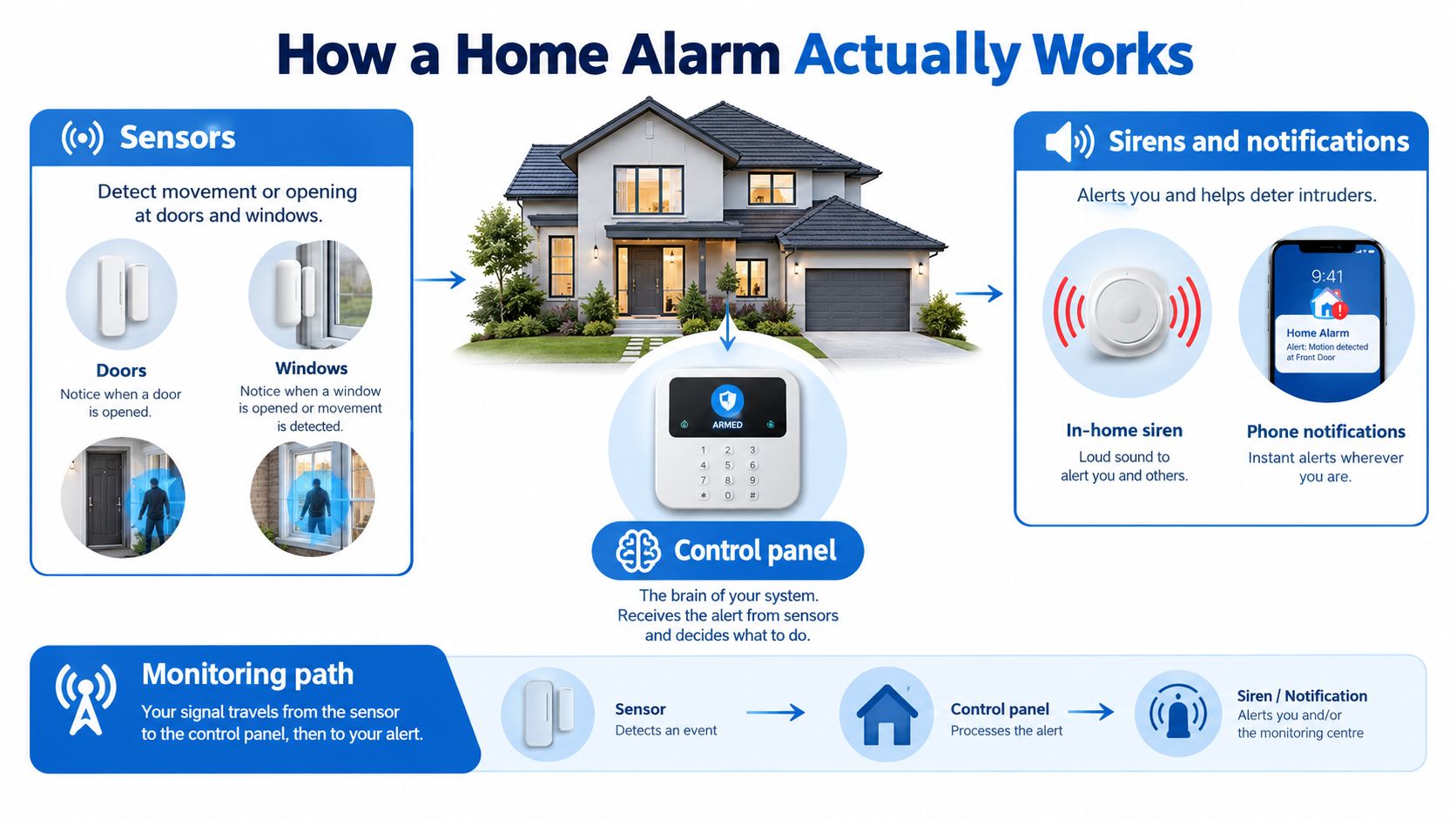
Door and window contacts notice an opening. A contact has two pieces, one on the frame and one on the moving part, and the panel registers a change when they separate. Indoor motion sensors notice movement inside a zone, usually through changes in heat patterns across their field of view.
From Sensor Signal to Somebody Acting
The control panel is the brain. It knows which zones are armed, which are bypassed for the night, and which entry points allow a short delay for disarming. When an armed zone triggers, the panel can sound internal and external sirens, send a push alert to an app, and pass a signal to a monitoring centre.
That chain only holds if power and communications hold. A battery backup keeps the panel running through a mains failure, and the communicator needs a tested path out when the internet drops. A panel that can't report is just a noise maker.
The short video below shows that signal path in action, from sensor to panel to phone.
Older national figures explain why this layer matters alongside locks and lighting. Australia recorded more than 335,700 household break-ins during 2009-10, and offender interviews in that research found 49.1% named a working alarm as a deterrent, below a dog at 61.4% but above internal lighting at 19.3%.
Western Australia Police added the qualification that shapes good design, as recorded in that same publication. Alarms work only when they're switched on. Clear away and home modes, app arming from the driveway, and a communicator tested at install close the gap between owning hardware and having protection.
Mapping Sensors and Zones to Your House
Component lists don't protect a specific floor plan. Placement does. Victoria Police treats a home as separate access points rather than a single entry, and that approach turns a generic kit into a plan a household can live with.
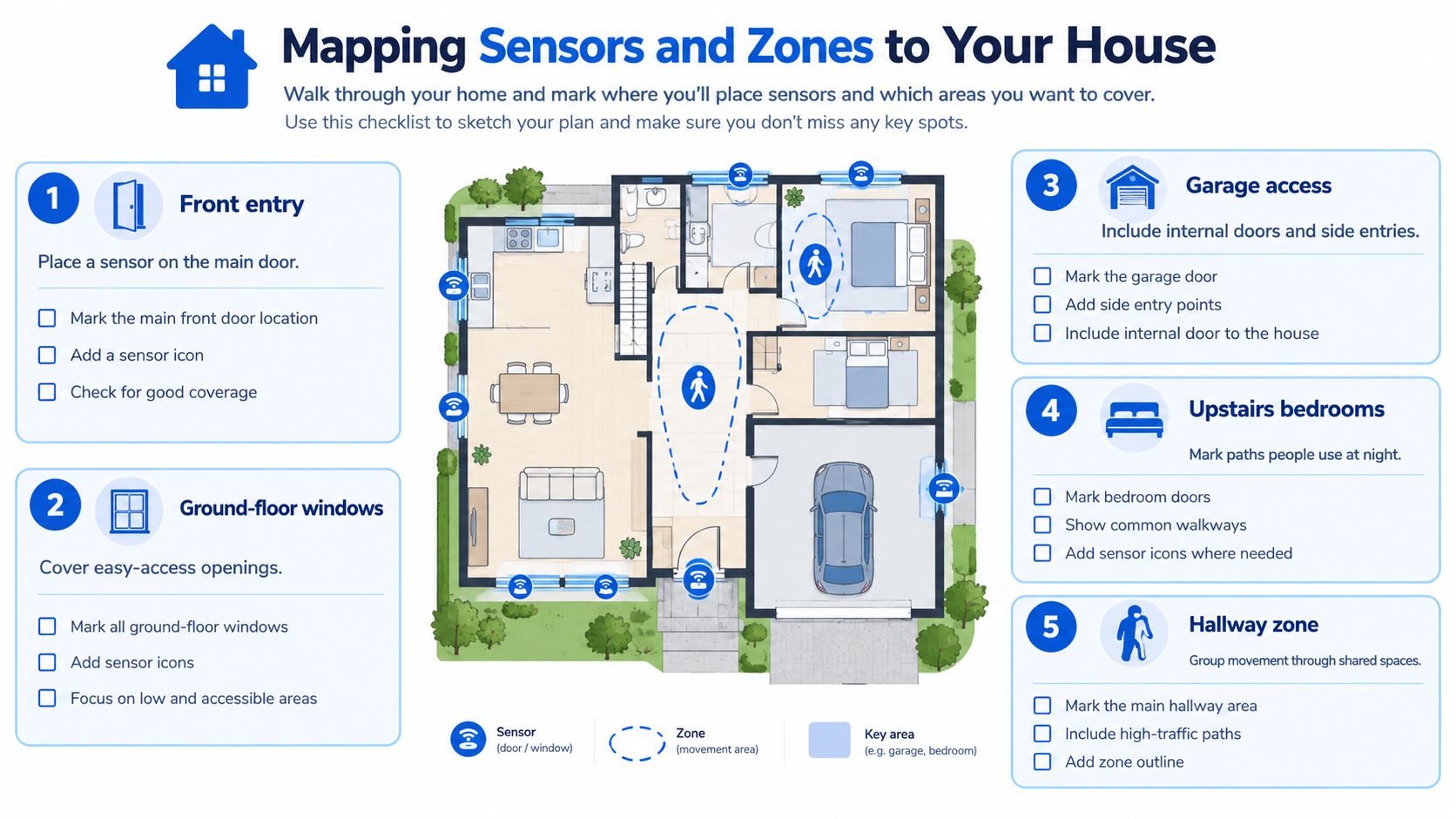
Start with a sketch. One page is enough. Mark every opening, then decide which ones stay armed while people sleep and which paths stay clear for children, pets and a trip to the bathroom at 2 a.m.
The floor plan below shows how those openings group into zones.
Building Zones a Household Will Use
Victoria Police lists external and internal garage doors, windows, gates, sheds, pet doors and skylights among the access points to check. Each one deserves a decision, even if the decision is a lock rather than a sensor.
Away mode: Arm every contact and selected internal motion zones because nobody should be moving inside.
Home or night mode: Bypass bedroom paths while keeping the garage, rear gate and ground floor windows armed.
Pet movement: Note where a dog or cat roams at night so a motion zone doesn't cover that path.
Suburb layout changes the weak point. In Brunswick, Coburg or Footscray, a rear laneway and detached garage often matter more than the front door, so the garage and side gate need their own zones. In Malvern or South Yarra terraces and family homes, a side return and pet door can sit out of sight from the street and get forgotten in a standard kit.
Deadlocks help during the day, but they must stay unlocked while occupants are inside so everyone can escape during a fire.
That safety point comes from the same police guidance and belongs in every install brief. List every opening, mark night bypass areas, note pet paths, and confirm emergency exits still work. Victorian guidance also expects equipment to comply with relevant Australian Standards and installers to be registered under the Private Security Act 2004, which is why a written, property specific plan beats a box of sensors chosen by room count alone.
Stopping False Alarms Before They Start
A well placed system can still cry wolf, and the cost is credibility. Victoria's crime prevention guidance warns that frequent false alarms can cause neighbours to disregard genuine activations, while regular testing and maintenance help prevent avoidable triggers. A siren nobody believes is close to useless.
Queensland Police identifies pests, pets, power interruptions or surges, telecommunications failures, poor installation, storms, unsuitable or obsolete equipment, drafts, objects moving near sensors and user error as the main technical causes. The mechanisms apply in Melbourne because they come from detector physics, environment and operating habits, not geography.
Matching Each Cause to One Fix
The fixes are mostly unglamorous, which is why they work.
Airflow and loose objects: Keep passive infrared sensors away from heating and cooling vents, curtains and hanging items that move.
Pets: Limit pet access to armed internal zones or use a pet aware layout that avoids free roaming paths.
Pests: Clear spider webs and insects from detectors during routine cleaning.
Power and communications: Test backup batteries and confirm the monitoring centre receives a signal after mains or internet loss.
User error: Change codes when housemates, tenants or tradies leave, and make sure every authorised user can arm, disarm and cancel.
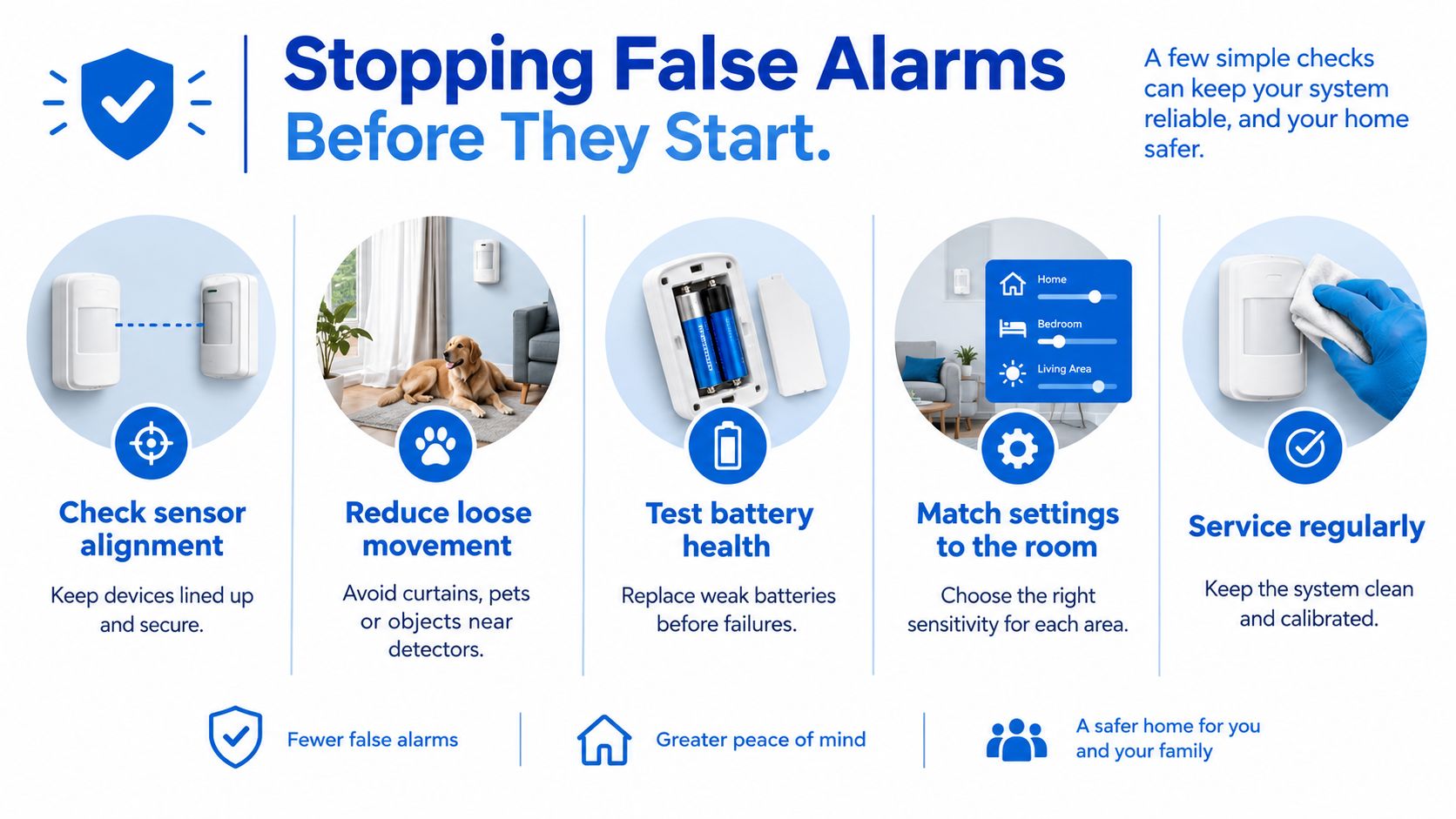
There's a design tension worth naming before any extra hardware gets added. Too few detectors leave blind spots. Overly sensitive or badly aimed motion sensors create nuisance alarms that train a household to ignore the app. More sensors don't automatically mean more security.
Commissioning should check detector coverage, tamper protection, battery condition, communications, siren operation and user procedures. That same check belongs in an annual service and after renovations or big furniture moves that change what a motion sensor sees. A monthly self test between services keeps small faults from hiding until the night the system is needed.
Choosing Local Sirens or Monitored Response
The siren is the loudest part of an alarm and often the least useful. Noise helps only when someone close enough hears it, recognises it as real, and decides to act while the house is empty.
That decision matters because weekday absence is normal in many Melbourne homes. Victoria recorded 27,953 home burglaries in the year to December 2025, with doors the most common entry point followed by windows, and approximately one in nine showing no forced entry. A response plan has to cover ordinary openings during school and work hours, not only smashed glass at midnight.
Locks and arming still come first. A monitored chain cannot rescue a rear slider left unsecured, a garage roller door left up, or a system nobody armed after the rushed departure.
Who Responds When the Alarm Sounds
Approach | Who is told | Works best when | Main weakness |
|---|---|---|---|
Local siren only | Neighbours and passers by | Someone nearby is home and willing to check | Nobody may hear it, or nobody acts |
App alerts only | The homeowner's phone | The owner keeps the phone close and can respond | A missed, muted or flat phone ends the chain |
24/7 monitoring | An operator following an escalation path | The house is empty for long stretches | Ongoing service cost and reliance on correct contact details |
Victoria Police residential guidance states that monitored intruder alarms are more effective because they alert the security company when an intrusion occurs. The practical difference is the external pathway. An app banner during a meeting, a flight, or a dead battery is information without action unless the owner can still call for help.
Before choosing, households can compare how professional alarm monitoring escalation works in practice. If an insurer asks for evidence of monitoring, an unmonitored siren has little to show beyond a noise complaint.
More cameras are not automatically better. Targeted coverage of entries and the perimeter verifies an alarm while limiting indoor surveillance.
PeakFriend Security scopes this choice through a free property specific assessment performed by a licensed installer. Its round-the-clock monitoring is offered as a service rather than assumed for every house, so the design should match occupancy: a home empty every weekday needs an operator in the chain, while a home with someone usually there may rely on sirens, good locks, disciplined arming and app alerts.
Alarm Plans for Different Melbourne Homes
Rules only help when they land on a real layout. Three common Melbourne property types show how the same principles produce different plans.
A Detached Family Home Empty on Weekdays
Consider a family home in Manningham or Whitehorse where adults work and children attend school. Australian Institute of Criminology analysis found residential burglaries were most likely between approximately 8:00 a.m. and 6:00 p.m., when properties may be unoccupied. For this house, the plan centres on door and window contacts, the internal garage door, the pet door and an external siren.
Scheduled arming or a phone reminder matters as much as sensor count. The system has to be on during those empty hours without relying on memory during a rushed school run. A camera at the front entry adds verification and a record, but it doesn't lock the garage door.
An Inner North Home With a Rear Laneway
A house in Brunswick, Coburg or Footscray with a detached garage opening to a laneway flips the usual priority. The front door faces a busy street and gets natural attention. The rear gate and garage sit quiet and hidden.
Here, the garage and side gate become their own zones, armed at night even while bedroom paths stay bypassed. A contact on the internal door between garage and house catches the second step, because entry to a garage isn't yet entry to the home. An external siren positioned to be heard from the laneway side changes the calculation for anyone testing that gate.
A Smaller Inner South Home or Rental
A compact home in Malvern or South Yarra, or a rental coordinated by a landlord, needs restraint. Fewer indoor cameras protect privacy, and targeted entry coverage does the verification work instead. Clear individual user codes for each tenant prevent the shared code problem, where nobody knows who disarmed the system or a former housemate still holds access.
Handover carries extra weight here. Every person needs to arm, disarm and cancel confidently, or false alarms follow within weeks. Where a household moves into a property with a partial existing system, an audit can bring serviceable equipment onto one app rather than ripping everything out.
Each scenario reduces to a one page brief for an installer. Openings, occupancy hours, pets, night bypass paths, and whether an operator or only an app should respond. That brief, written before product selection, keeps the trade offs visible.
Book a Property-Specific Alarm Assessment
The most useful next step takes a pen and ten minutes. Walk the property once and write down every external door, window, garage door, gate, shed and pet door. Add who is home on weekdays, which paths must stay clear at night, and where pets roam. That page exposes the forgotten side door faster than any product catalogue, and it gives an installer something real to work from.
A free security assessment turns that walk into a design for the actual house. PeakFriend Security provides the assessment free for potential customers, and it is performed by a licensed installer who checks locks and arming habits first, then maps zones, verification and response around the gaps. Households who want to know what happens next can read about what professional security system installation involves from assessment to handover before booking, so the right questions are ready on the day.
What the Assessment Should Produce
Expect the assessment to start where break-ins start: the doors, the locks, and whether anyone arms the system on a Tuesday morning. A weekday-empty house in Footscray with a laneway garage needs different zones and a different response path than an occupied terrace in South Yarra, and the plan should say so in writing. Every system PeakFriend designs is suited to the site, the people using it, and the level of risk, with transparent pricing and flexible options, no unnecessary equipment or hidden fees.
The reason this matters is written into why the company exists. PeakFriend was built to fix the problem that most security companies install a system and disappear, leaving customers with a phone notification and a call-centre queue when an alarm goes off. Ask who responds when the alarm trips, what the operator sees, and how a false alarm gets cancelled. The answers separate a monitored service from a noise maker.
The action is specific. Request the free assessment for the actual address, hand over the handwritten list of openings, and ask the resulting design to name each zone, the night bypass paths, and who responds when a sensor trips. A home burglar alarm system built from that walk protects the way a particular household lives, rather than the way a generic kit assumes it does.
PeakFriend Security designs and installs home burglar alarm systems around the actual openings, occupancy hours and laneways of each Melbourne property, backed by round-the-clock alarm monitoring. Households ready to turn a handwritten list of doors, windows and garage access points into a protection plan can book a free assessment with a licensed installer through PeakFriend Security.