
Small Business Alarm System Cost in Melbourne

A simple Melbourne shop or office commonly costs AUD 1,800 to 4,000 for an installed alarm, with packaged systems starting at $1,400, $2,050 and $2,800. Monitored commercial installations often cost AUD 2,600 to 6,800.
The useful comparison isn't between control panels. It's between the cost of protecting a particular premises and the stock, repairs and interrupted trading an intrusion could leave behind. A Malvern consulting room, a Chapel Street retailer and a Braeside warehouse need different protection, even when their owners start with the same budget.
Table of Contents
Melbourne Alarm Prices You Can Budget Today
AUD 1,800 to 4,000 installed is a sensible planning allowance for a small shop or office with a single main area, ordinary access and basic communications, according to the Security Wholesalers commercial alarm cost guide. Its indicative split is AUD 900 to 2,000 for equipment and AUD 900 to 2,000 for installation labour.
That distinction matters on Glenferrie Road in Malvern. A compact shopfront with accessible ceiling space is a different installation from a deep tenancy with a rear storeroom, concealed wiring and separate delivery access. The panel might be similar; the work needed to protect the premises isn't.
Installed small-business alarm budgets, Melbourne 2026
The following are planning bands and package starting prices, not a fixed invoice for every Melbourne address. The monitored installation allowance includes a broader communications and response scope, with its recurring charges examined separately below.
Scope | What is included | Installed budget (AUD) | Best fit |
|---|---|---|---|
Equipment share of a small shop install | Panel, contacts, sensors, siren | 900–2,000 | Parts benchmark only |
Labour share of a small shop install | Cable, mounting, programming, test | 900–2,000 | One main area, ordinary access |
Small shop or office installed | Equipment plus labour, basic communications | 1,800–4,000 | Single trading area |
Entry package | Professionally installed alarm, app, monitoring as standard | From 1,400 | Simple layout, lower risk |
Plus package | Broader detection and coverage | From 2,050 | More doors or a stock room |
Complete package | Full coverage within the agreed scope | From 2,800 | Higher exposure or mixed risks |
Monitored small-commercial install | Alarm plus monitoring communications and response | 2,600–6,800 | Insurer or after-hours response need |
PeakFriend Security's Entry, Plus and Complete starting prices are $1,400, $2,050 and $2,800, respectively. Professional installation, app access and monitoring are standard inclusions, while the final price follows the site's layout, coverage area and selected protection level.
A package starting below the general installed benchmark isn't automatically incomplete. It can suit a simpler scope. However, “monitoring included” must be translated into written terms identifying the recurring subscription, any included service period and what happens afterwards; it shouldn't be read as free monitoring indefinitely.
Choose by coverage, not package name
For a single-room tenancy with little portable stock, Entry is the sensible starting tier. A shop with a stockroom and additional entry routes should start the discussion at Plus. Multiple doors, sensitive areas or integrated cameras justify Complete or a custom design.
The written scope should identify:
Detection: Detector count, door contacts and protected zones.
Warning and reporting: Siren locations and the communications path.
Configuration: User programming, app setup and access permissions.
Completion: Commissioning, input testing and an onsite handover.
A camera shouldn't be assumed to be included because a package has a broader name. Each camera, recording device and storage service needs its own line. Comparing the panel alone leaves the labour that closes detection gaps out of the decision.
What One Break-in Costs Against the Quote
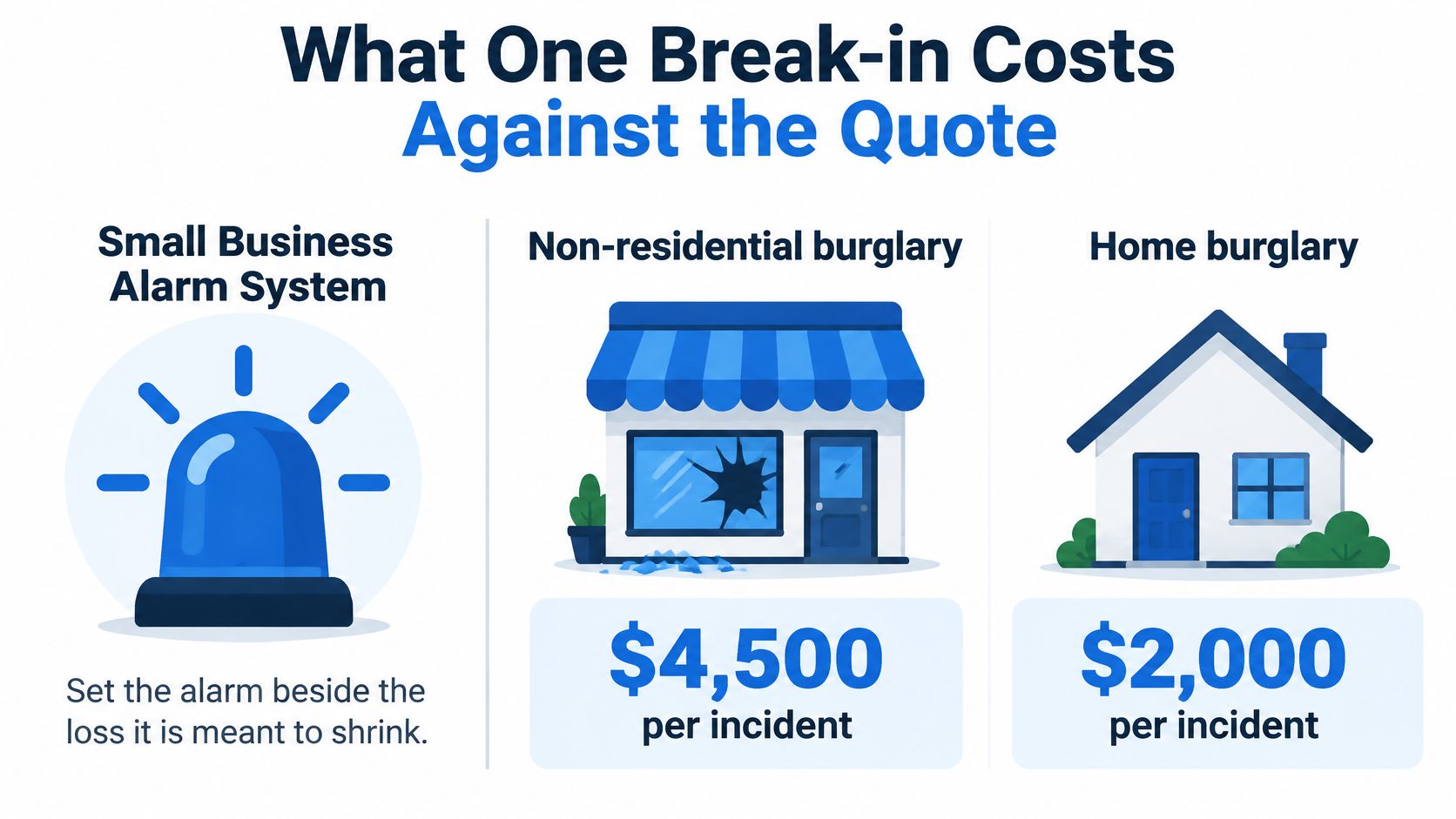
About $4,500 per non-residential burglary, compared with $2,000 per residential burglary, is the historical benchmark estimated by the Australian Institute of Criminology. The same analysis found non-residential burglaries represented 18% of burglaries but 32% of the total burglary cost, within an overall Australian burglary bill of approximately $2.43 billion.
Those are historical national estimates, not a forecast for a particular Richmond, Footscray or Dandenong premises. Their value is in showing why business security deserves a loss-based budget rather than a gadget budget.
The comparison below puts the installation decision beside the incident it is intended to limit.
Build a premises-specific loss note
A business owner can replace the national benchmark with a practical worksheet:
Stock and tools: Replacement cost of portable goods, specialist equipment and anything stored near an accessible exit.
Forced-entry repairs: Likely work on the vulnerable door, glazing, frame, lock or roller shutter.
Lost trading: Gross takings for a lost trading day, recorded separately from the profit lost.
Gross takings are a useful disruption flag, but they aren't the same as an insured financial loss. A proper calculation also distinguishes recoverable stock costs, policy excesses, continuing wages and expenses that stop while the business is closed. Otherwise, the owner risks counting the same loss twice.
A Footscray workshop might lose relatively little retail stock but be unable to fulfil bookings without its diagnostic equipment. A Richmond clothing shop may face both missing inventory and an unsecured frontage that needs urgent repair. The appropriate alarm budget follows those consequences, not the postcode alone.
Budget rule: Treat an alarm like a seatbelt. The relevant comparison is the damage it can help limit, not the price of the buckle.
Expected loss isn't a guaranteed saving
Security spending is insurance-like loss control, not an insurance policy. An alarm doesn't reimburse stolen goods, guarantee an arrest or prove that an incident would otherwise have occurred.
The economic test is whether the proposed detection and response can reduce a credible loss enough to justify its lifecycle cost. The Australian Bureau of Statistics discussion of crime costs identifies insurance, surveillance equipment and security services as costs businesses already carry. Those commitments belong in the same protection plan, rather than in disconnected purchasing decisions.
What Pushes a Melbourne Quote Up or Down
A Carlton corner café with a straightforward entrance can need less installation work than a retailer near Chadstone with a rear lane, cool room and roller door. Floor area alone won't explain the difference. Entry routes, working access and the consequences of a missed event matter more.
Pricing only the panel is like pricing an oven and ignoring the wiring. A capable installer has to create a working system around the building, staff routines and communications infrastructure.
Labour is the first place to look
The main cost drivers should be examined in a practical order:
Long or concealed cable routes: Finished walls and inaccessible cavities require more careful routing than an open ceiling.
Additional entry points: Each door, shutter or vulnerable opening needs a deliberate detection decision, not an assumption that a distant motion sensor will cover it.
Duress and panic devices: Placement must match where staff can safely activate them.
CCTV and access-control integration: Separate devices need coordinated permissions, event records and testing.
Difficult ceilings and tenancy restrictions: Access approvals, protected finishes and restricted working hours affect installation effort.
External detection: Docks, gates and exposed perimeters need suitable positioning and calibration around legitimate activity.
The cheapest workable scope removes unnecessary equipment, not necessary coverage. PeakFriend Security custom-designs systems around business operations with transparent pricing, flexible options and no unnecessary equipment or hidden fees. Its supported technology includes Hikvision, Ajax, Dahua, Bosch and Uniview.
Melbourne scenarios that justify different spending
These are illustrative planning scenarios, not promises of identical results at every site.
Braeside distribution facility. The incident to design against is overnight stock removal through a loading area. Perimeter detection, dock and gate cameras, and monitored escalation are a better starting point than internal sensors alone. The installer needs to understand where pallets wait, which gates remain accessible and when cleaners or drivers legitimately attend.
Dandenong large-format store. A vehicle-damage dispute at the forecourt needs usable evidence, not merely an alarm activation. Entry and forecourt cameras should capture the relevant movements, while retention should match the centre's actual claim window. Remote access for the duty manager matters because an incident may be reported when that manager isn't onsite.
South Yarra office across three levels. An unauthorised visitor entering a vacated floor calls for tenant-specific access and independently managed alarm areas. A floor-by-floor fitout commissioned outside business hours avoids turning a security upgrade into a trading interruption. That staged approach also allows access permissions and staff training to be checked before the next floor changes over.
A hypothetical 90-place Malvern childcare centre. An unauthorised entry and inappropriate footage access are separate risks. Cameras should be limited to justified entry, play-area and perimeter views, with role-locked recordings and logged front and side doors. Buying more cameras without controlling who can watch them would be the wrong upgrade.
A higher quote is justified when it closes a named exposure. Extra equipment without a named purpose is simply extra spending.
Photos that make the quotation useful
A useful photo pack shows every external door, the ceiling construction, the switchboard location, the communications equipment and the actual stock positions. A close-up of a roller-door frame can reveal a mounting problem that a floor plan misses.
The owner should also mark shelving that might block a detector and identify doors left open during deliveries. These details let the installer design around normal operations instead of creating a system staff are tempted to bypass.
Five-Year Monitoring Costs After Install Day
Monitoring is a communications and response service, not a sticker on an alarm panel. The Victorian commercial security cost guide from The Quote Yard gives an indicative monitored installation allowance of AUD 2,600 to 6,800, with monitoring commonly AUD 40 to 160 a month, adding AUD 2,400 to 9,600 over five years before maintenance or call-outs.
Adding the matching endpoints produces a calculated AUD 5,000 to 16,400 installation-plus-monitoring allowance over that period. That's a budgeting envelope, not a promise that every installation and service combination is available at either endpoint.
Monitoring fees and five-year running cost
The service descriptions below are comparison categories. They aren't guaranteed inclusions at a particular price, so the contract must identify the actual workflow.
Monitoring level | Typical monthly fee (AUD) | Five-year fee (AUD) | What you actually get |
|---|---|---|---|
Notification only | About 40 | About 2,400 | App or message, no operator workflow |
Standard commercial monitoring | Mid-range inside 40–160 | Mid-range inside 2,400–9,600 | Operator verification and an escalation list |
Higher response tier | Up to about 160 | Up to about 9,600 | Dual-path reporting and guard or patrol options |
Dual-path signalling | Included in some higher tiers | Priced within the agreed five-year band | Internet plus mobile backup if one path fails |
The important question is what happens when nobody answers the first call. A service that stops at a push notification is different from an operator checking an event, calling the nominated contacts and following a documented escalation procedure.
Dual-path signalling generally uses fixed internet with mobile-network backup. The Victorian guide identifies it as an arrangement commonly expected by commercial insurers and franchise agreements. The business still needs its own insurer's requirements in writing.
Pay for a response that can actually happen
Simple Business Monitoring and Business Monitoring Pro are available plan names, but their names alone don't establish which verification, attendance or maintenance features apply. The business alarm monitoring service also provides sensor alerts, system activity logs and device-status information.
For a warehouse containing portable stock, operator-led monitoring with an agreed escalation process is the recommended baseline. An unattended phone isn't an effective response plan.
A complete ownership total should separate:
Communications: SIM charges, internet reliance and outage reporting.
Maintenance: Sensor, battery and connection testing, plus replacement parts.
Response: False-alarm attendance, guard dispatch and other call-out charges.
Video services: Cloud storage, retention and remote-viewing subscriptions where applicable.
Package inclusions must be reconciled before adding charges. If a subscription or maintenance allowance is already included, it shouldn't be counted again. The owner needs a single written total showing exactly what remains payable after installation.
Packages for Shops Offices and Warehouses
Falling burglary doesn't mean a Melbourne retailer needs less security. RACV's Victorian retail security coverage reports 42,692 burglary victims in 2025, down 7% year on year, alongside 41,547 thefts from retail stores, up 6.1% from 2024 and 47.1% from 2023.
That split calls for different tools during trading and after closing. The comparison below separates those jobs.

Nationally, the ABS theft release recorded 595,660 victims of other theft in 2024, the highest number in its 21-year series; retail locations accounted for 45% of those thefts, compared with 32% in 2010. A Chapel Street shop therefore shouldn't rely on a night alarm to address losses while customers and staff are inside.
Which package fits which Melbourne business
Starting tiers indicate the appropriate quotation discussion, not a guarantee that every listed device fits within the advertised package floor.
Premises | Main loss to design for | Include | Starting tier |
|---|---|---|---|
Studio or professional office | After-hours break-in | Door contacts, motion, siren, app, basic monitoring | Entry from $1,400 |
Small retail shop | Shop-floor theft plus night intrusion | Alarm plus cameras on till, stockroom and entries | Plus from $2,050 |
Childcare or privacy-sensitive site | Unauthorised entry and footage access | Limited cameras, role-based viewing, logged doors | Complete or custom |
Warehouse or large-format retail | Dock, gate and after-hours stock loss | External detection, dock cameras, 24/7 monitoring | Custom, often above the small-shop band |
A Southbank professional office with little stock can start at Entry, provided its entry routes and valuable equipment are properly covered. A retailer should start at Plus with explicitly quoted CCTV, rather than assuming a broader alarm package automatically includes useful footage.
For warehouses and large-format retail, custom perimeter protection and monitored response are the stronger choice. The commercial security system options also address high-liability premises, including childcare centres, where authorised-staff-only footage access matters as much as camera placement.
The following video provides additional context for comparing business security options.
After-hours users can change the recommendation. Cleaners, couriers and rotating duty managers need individual permissions and a workable arming routine. A system that suits the building but not its users will create avoidable bypasses and nuisance events.
Brief a Melbourne Installer and Compare the Quote
A useful next step is a property-specific assessment this week, not another search for the cheapest panel. PeakFriend Security provides free assessments performed by a licensed installer, with a written protection plan delivered within one day.
Based at Level 1, 123 Glenferrie Road, Malvern, the business serves Greater Melbourne. Its no-lock-in arrangements, dedicated support contact and documented installation standards give owners concrete terms to compare alongside equipment and response coverage.
The assessment process should produce a clear scope, not just a package recommendation.

A briefing checklist ready to send
Sketch the floor. Mark entrances, stockrooms, restricted rooms and areas occupied after normal trading.
Photograph each external door. Include shutters, delivery access and surrounding mounting surfaces.
Write down stock and equipment values. Separate easily carried goods from machinery whose loss would stop operations.
Record insurance requirements. Identify whether an insurer or franchisor needs a monitoring certificate or particular reporting arrangement.
Identify the monitoring operator. Request the applicable licensing, response procedure, escalation contacts and incident-record process.
Document footage controls. Establish who can open recordings, where they're stored and how long they're retained.
Request comparable written totals. Obtain installation and lifecycle pricing on the same scope, with equipment, labour, monitoring, maintenance and optional access control separated.
Victoria Police's private-security fee guidance identifies regulated monitoring activities and licensing arrangements, with fees prescribed under the Victoria Police (Fees and Charges) Regulations 2024. The monitoring provider should identify who performs the work, rather than leaving the owner to assume an app alert constitutes a licensed monitored service.
Privacy belongs in the purchasing decision
The OAIC security-camera guidance states that organisations covered by the Privacy Act must meet Australian Privacy Principles when footage contains personal information, including notification, security and appropriate destruction or de-identification. Camera placement therefore needs to account for neighbouring properties, public areas and unnecessary recording.
The written handover should include account ownership, staff permissions and removal of departing users. The security systems installation guide offers further preparation context.
The strongest quote names the loss, shows the coverage and explains the response. The lowest panel price does none of those things by itself.
PeakFriend Security offers property-specific alarm, CCTV, access-control and monitoring systems across Greater Melbourne, starting with a free assessment by a licensed installer. Business owners can visit PeakFriend Security to arrange an assessment and request an itemised installation and five-year service total matched to their premises, stock and operating hours.